Harvested from trees in large stalks containing many bunches, bananas make their way on wire trolleys, mule carts, tractor-drawn trailers and railroads, to processing sheds where they’re washed in water tanks to minimize bruising. After they’re separated into bunches, the stems are coated to prevent contamination and extend the life of the fruit. And once sorted and packaged for shipment, they’ll make their way on narrow-gauge railroads to climate-controlled ships, destined for grocers and consumers around the world.
Until recent years, banana production was a rudimentary process. Producers were only estimating the amount of fruit being taken in and shipped out, and consequently, giving away a lot of product in the process. In an effort to feed the world’s ever-growing demand for this meal in a peel, companies like Dole®, Chiquita®, and Del Monte®, all with facilities in Central America, have made significant advances over the last 20 years—thanks in part to Luis Rodriguez and his team at Representaciones Roma, S.A. Using Rice Lake’s 820i and 920i digital weight indicators, Rep. Roma created the now popular BANAWEIGH®, BANACHECK® and PE820 systems, now used in modern banana processing plants throughout Costa Rica and Central America.
BANAWEIGH
Rep. Roma’s banana-branded products were conceived when producers began looking for ways to get reliable information about the fruit coming into the boxing plants. They wanted to weigh 100% of it, and identify each stalk by the area of each farm that it originated from. Because each stalk is assessed for quality and sorted by grade before packaging, the eventual goal would be to use that information to improve the growing conditions in lower-performing areas.
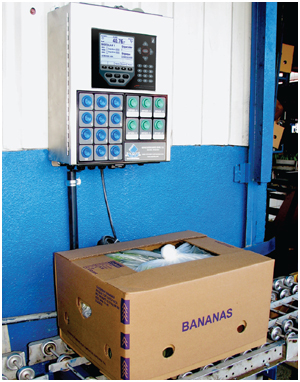
Rep. Roma’s BANAWEIGH system uses his own monorail scale and customized 920i wall-mount indicator from Rice Lake. As the stalks are harvested they’re tagged by color, corresponding with BANAWEIGH’s color-coded front panel to identify the farm of origin. As fruit crosses the monorail, BANAWEIGH stores and transmits information about the weight of each stalk, origin, age of the fruit, harvesting crew, and carrier to the boxing plant. An operator randomly inspects the fruit, and also enters information like number of clusters (bunches) on the stem, number of bananas on each cluster, and average length and diameter. All of this information is transmitted in real time to a mainframe computer via Ethernet. Producers are using the information to monitor inventory of fruit at the farm, learn more about the performance of each lot or section at the farm, test new growing practices and more.