The first wireless message sent over the open sea was “Are you ready?” Guglielmo Marconi sent that message across the Bristol Channel over a distance of a little under four miles, a record for wireless broadcast distances and the first to prove that wireless communication over long distances including ships at sea was possible.
Ready or not, ever since that day—May 13, 1897—the use of wireless communication has continued to increase in both distance and capability. Wireless communication has been all around us, invisible to all but those who are actively using it.
Today, turning on a radio, TV, or GPS, using a Bluetooth® headset for our phone, or even a laptop in a coffee shop, transforms us into users of wireless technology. There are many different uses, implementations, applications, and frequencies in use today. They all co-exist in the same air space that we live in, blissfully unencumbered by its presence until we request it.
In this article, we look at three specific implementations, their uses, and advantages and disadvantages for certain applications: Bluetooth, ZigBee®, and Wi-Fi.
Bluetooth
Bluetooth was initially just a code name for the technology and was taken from the nickname of Harald Blåtand who was the King of Denmark between AD 940 and AD 985. The rumor was that the Danish king was given the nickname “Bluetooth” because he was so fond of blueberries that his teeth were stained blue. The founders of the Bluetooth SIG (Special Interest Group) felt that the name was appropriate because Harald Bluetooth and the technology are both of Scandinavian origin. Just as King Harald Bluetooth united the warring factions in parts of what are now Norway, Sweden, and Denmark, Bluetooth technology unites multiple forms of wireless communication such as the computing, mobile phone, and automotive markets into a single, secure, low-power, low-cost, globally available radio frequency.
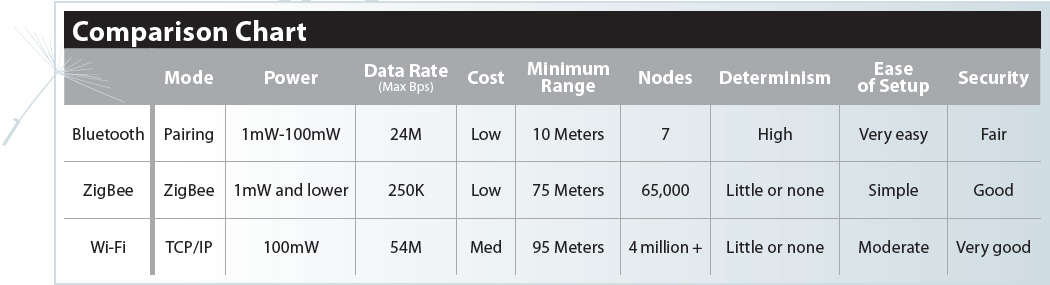
Bluetooth wireless technology is geared toward voice and data applications in what is referred to as a Personal Area Network. Bluetooth wireless technology operates in the unlicensed 2.4 GHz spectrum, and is therefore able to penetrate solid objects. The range of Bluetooth wireless technology is application specific. The Bluetooth Specification mandates operation over a minimum distance of 10 meters or 100 meters depending on the Bluetooth device class, but there is not a range limit for the technology. Manufacturers may tune their implementations to support the distance required by the use case they are enabling. Bluetooth technology sets up a Personal Area Network and is primarily used for connecting devices in a small physical perimeter.
A maximum of seven devices can be paired with a master device. The master device is placed in a discovery mode, and the slave device is also placed in a pairing mode. When the master detects the slave device, a confirmation is usually required. Once this is acknowledged, the master can be placed in a mode that will always acknowledge the slave with or without a manual confirmation. Manual confirmation is slower but more secure. Also, master units can be set to non-discoverable mode to prevent them from sending out discovery packets.
Technical Specs
Bluetooth uses adaptive frequency-hopping spread spectrum modulation (AFHSS), which uses 79 channels or frequencies at 1 MHz intervals between 2.4 and 2.485 GHz. It is unlicensed in most countries. Because of this, it can easily co-exist with other technologies and modulation schemes even in the same frequency.
The peak data rate of Bluetooth technology depends on the version and power, which ranges from 2.5 microwatts (low energy) and 1-3 Mbps to 2.5 milliwatts with a data rate of up to 24 Mbps.
Bluetooth technology is omnidirectional and does not require line-of-sight positioning of connected devices.
Security has always been and continues to be a priority in the development of the Bluetooth specification, which allows for three modes of security.
The cost of Bluetooth chips is under $3.