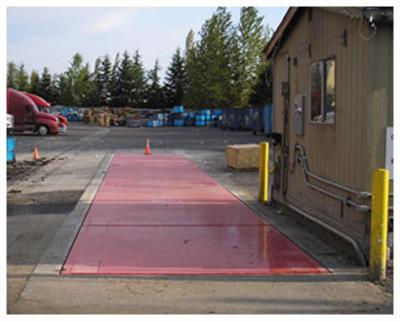
Maintaining Your Truck Scale
History tells us that a well-designed and heavily built truck scale can keep ringing for 30 years or more if the site is properly prepared, the scale is installed correctly, regularly serviced, and diligently maintained. The life expectancy of any truck scale is also dependent on environmental factors unique to each industry. But even the lifespan of a light-weight truck scale in a corrosive environment will be greatly extended by proper preparation, installation and maintenance.
The following is a true accounting of a truck scale that failed after a short ten years of trouble-filled service. Todd Thompson, U.S. Scale, Seattle, WA, recently retrofitted a pit-type scale at a paper recycling facility. According to Todd, "Poor scale maintenance is often the cause of failure with pit-type scales in environments like waste collection plants. This truck scale collapsed because seepage and wet paper collected in the pit. The humidity produced by that debris caused the stands to rust out and weakened the deck."
Todd does not hang all the blame on maintenance. "This was a difficult-to-impossible scale to maintain. The recycling corporation was constantly having to re-cal. When the original pair of 70 pit-type mechanical truck scales were installed, one pit was a little lower than the other. They put a sump pump in the lower pit. It was a bad location for the pump because it was quite a distance from the manhole. Somebody would have to crawl through it to remove debris. It smelled like an open septic tank, so I can see why no one raised their hand for the job."
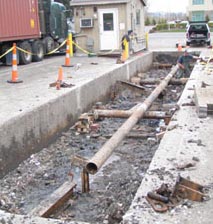
Todd recalls, "The original scale was in service nine years when a larger sump pump was installed. We didn't do that work on the scale, but the pump didn't fit all the way down into the pump hole, so it couldn't pump out all the water. Finally one of the stands rusted through and broke apart, and the scale collapsed. Then the scale maintenance crew jacked up the scale and welded the stand. The scale lasted one more year.
"We knew we had to solve the site drainage problem first. There was a trough through the parking lot and the runoff seeped into the scale pit. We broke open the side of the trough and core-drilled an eight-inch hole into the side of the scale. We installed a vault with a manhole and connected it to the scale with a six-inch pipe. A three-inch discharge pipe was installed that led from the pump in the manhole to the trough. Next we shoveled out and pressure-washed the pit and epoxied exposed rebar to reinforce the concrete pillars and hold them to the walls and poured the concrete for the stands.