Whitecrest Mushrooms Ltd. Farm in rural Putnam, Ontario, has one of the most high-tech mushroom plants in the world —producing two million pounds of brown mushrooms a year. Nevertheless, people still do the picking. It takes several months’ experience and a practiced eye to know when to pick a button Crimini and when to let it mature to a steak-size Portobello. Perfectly ripe mushrooms vary from small buttons to large caps.
Murray and Chantelle Good purchased the farm in 2001. In June of 2010, lightning struck the nursery building, and it burned to the foundation. Murray turned the loss into an opportunity—by building a bigger, better nursery. This time around, Murray wanted a completely automated system that one day would produce controlled, traced mushrooms not touched by human hands between picking and purchase. The less mushrooms are touched the better—for both mushroom and bottom line. To Murray, employing the system of 22 CW-90 checkweighers is a major step in reducing the handling of mushrooms.
“Mushrooms are fungi, but they are commonly thought of as a vegetable—so we’re competing with other vegetables,” Murray explains. “Our price is high in comparison because our cost of production is high—50 percent of our total expense is labor. We want to get that down to 25 percent. With robotic-picking, we can pick twenty-four hours a day. Every hour a mushroom grows four percent, so in a day it doubles in size. If we’re picking twenty-four hours a day we’re getting more efficiency out of our beds.”
Mushrooms are the only “vegetable” that makes Vitamin D itself. “We can enhance that with UV light. We also make a mushroom powder that companies use to enhance soups, sauces, yogurt, and bread. Mushrooms are a good source of umami, so instead of adding salt, mushroom powder can be added for a savory flavor.”
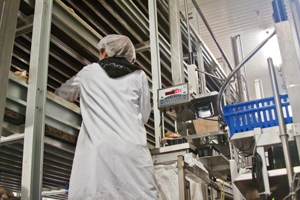
22 CW-90s are wirelessly connected to the host and mounted on carts that roll along the aisles and can be elevated so the picker has access to all seven tiers of mushroom beds.