


At 9:20 a.m. on Wednesday, June 11, the National Weather Service reported that the Cedar River reached a record 20.01 feet in Cedar Rapids. The old record of 20 feet was reached in 1929, and thought to have also been reached in 1851. The weather service jumped its forecast for the Cedar Rapids crest expected on Friday from 22.1 feet to 24.5 feet, two feet below the projected "500-year flood" crest.
Cedar Rapids city officials expanded the mandatory evacuation area to match the 500-year flood map. Police officers stood in knee-deep water as they unsnarled backed-up traffic attempting to cross the First and Second Street bridges before they were closed or inundated. Railroad cars filled with rock ballast were parked atop a bridge just south of downtown to try to prevent the river from carrying the span away.
Thursday morning, the bridge lay toppled on its side, white water rushing over the girders. People could be seen dragging suitcases up closed highway exit ramps to escape the water.
One resident reported brown flood water lapping at the edge of her backyard at 11 a.m. and by 3:30 p.m. the basement was inundated and the pressure of the water had cracked the foundation.
By Thursday afternoon, the Cedar River was 29 feet deep, or 17 feet above flood stage. Brian Pierce, a meteorologist with the National Weather Service in Davenport, said, "We’re in uncharted territory — this is an event beyond what anybody could even imagine."
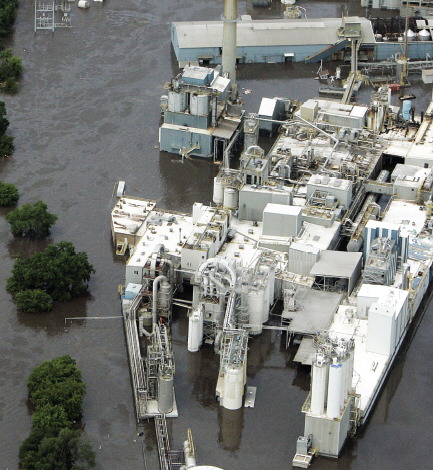
Finally, on Friday the 13th, the Cedar crested at Cedar Rapids at 31.12 feet, a stunning 11.12 feet of petroleum- and garbage-polluted water above the previous flood of record set in 1929 and 19.12 feet above flood stage. Most of downtown Cedar Rapids was underwater, including city hall and the county courthouse and jail, all built on an island in the middle of the river.
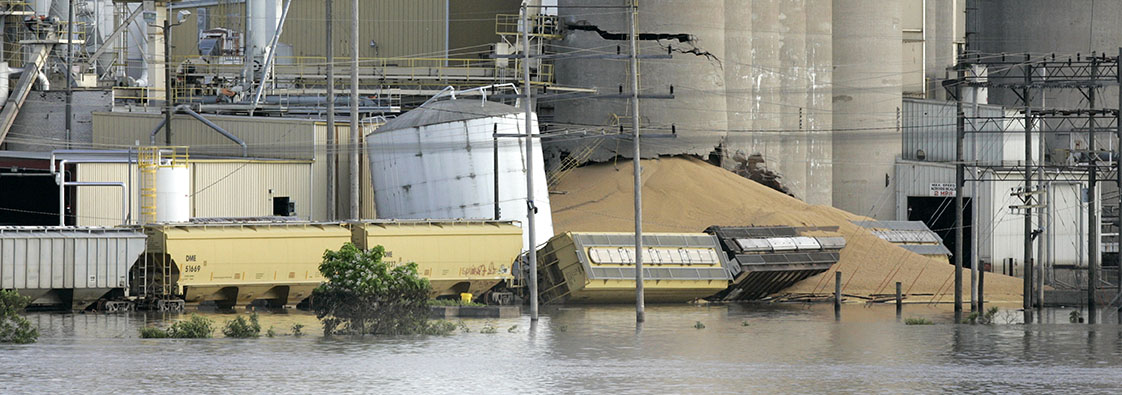
At the Cargill corn processing plant spread out along the south side of the river, the floodwaters were rushing through the silos, bins and buildings, sweeping heavy equipment along with the surge. By Sunday, the Cedar had receded five feet but it would be three more days before the river dropped enough so crews could begin pumping water, and another week before the river fell below flood stage.
With the Cargill corn milling facility closed, the company was forced to declare "force majeure" on corn syrup contracts. This means the company would not be able to meet all of its customers’ contract volumes, and supply of corn syrup would be limited until the situation was resolved. Resolving the situation started with mucking out the mess.