Design
The five most important factors to consider when designing a WLAN system are data, location, frequency, power and antenna type.
Data
Depending on your frequency, you may get more range but less data speed or less range and more data speed. Transmitting a weight every one-tenth of a second requires a very low rate of data transfer, therefore you can have an increased range. However, if you are transmitting a real-time video requiring more data per second, you will need to decrease your range in order to uphold the quality of the data. Evaluate your project needs before selecting a particular frequency and/or protocol.
Location
Ideally, you want your two antennas to be within line of sight of each other without obstructions. If this is not possible, look for alternatives, like adding wireless access points.
For optimal performance, it is always best to keep radios and their antennas as close to each other as possible. Adding cable between the antennas and the radios can drastically reduce the range if not done exactly right. For outdoor applications, special radios with IP67 rated enclosures are available. Another method is to install the radio in a weatherproof enclosure with an external antenna.
If a line of sight is impossible, look for the minimum amount of metallic and EMI sources between antennas, avoiding liquids at all costs. If these are not possible, then repeaters may be necessary. Also look at the orientation of the antennas; they should be parallel to each other with the lengths facing each other.
If you cannot achieve a clear line of sight between your antennas, the table on this page shows the interference potential of various materials.
Frequency
In order to analyze the frequency of your environment, you will need to analyze the electromagnetic interference and other wireless systems first. Using the 2.4 GHz spectrum, the software on your Wi-Fi enabled laptop can help you with this analysis. If not, free software packages are available on the Internet. Another way to test the frequency of your environment is to use the free software available from radio manufacturers. With the radios, you can test the communications between both or all points. Generally, the two main frequencies that allow unlicensed operation are in the 2.4 GHz and 900 MHz range. However, there are many other devices that use radios in the same frequency range.
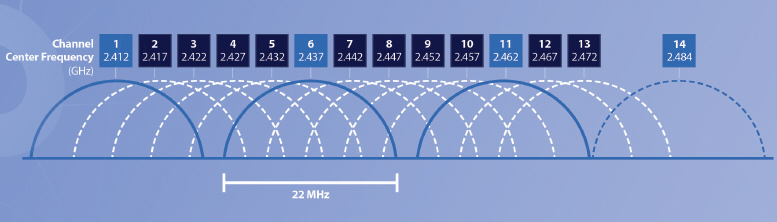
Depending on the frequency, there are a number of channels available. Sometimes choosing the correct (least used) channel can make all the difference! The 5 GHz spectrum is divided up into a number of different channels.
Notice that channels 1, 6, 11 and 14 are the only groups that do not overlap.