


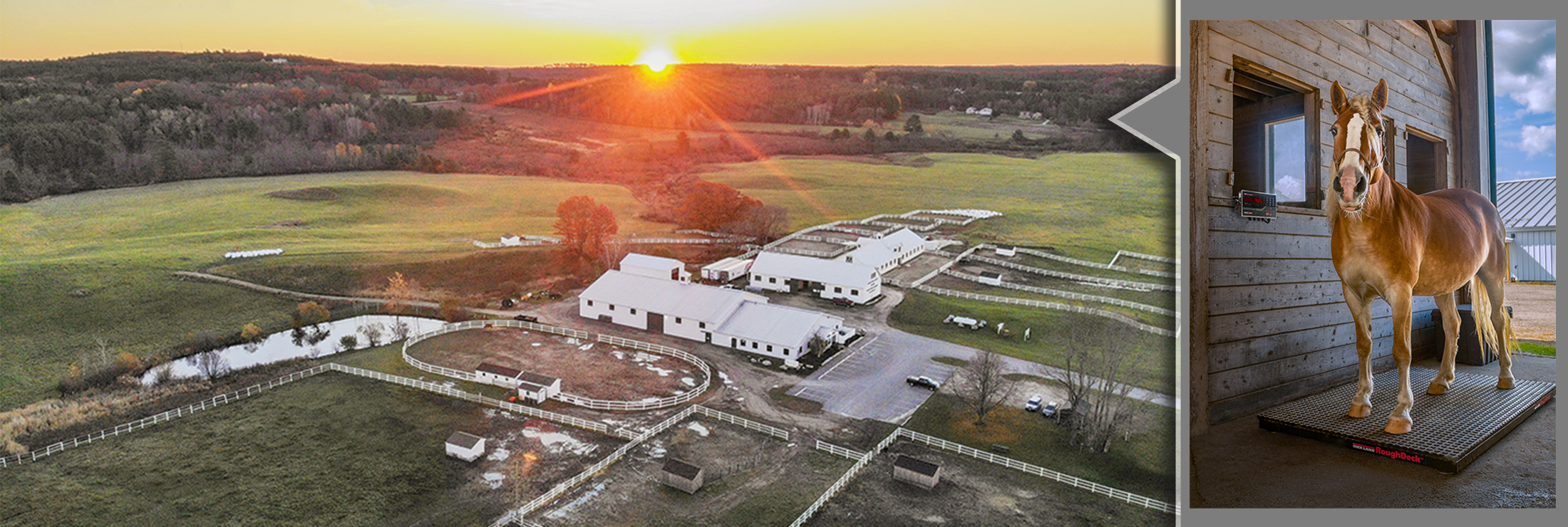
A Sanctuary for Neglected Horses
The Maine State Society for the Protection of Animals (MSSPA) rescues and rehabilitates abused and neglected equines. With hundreds of horses rescued, their services are integral to the equine community in Maine and beyond. Many horses arrive severely malnourished and underweight, and each horse is placed on an individualized re-feeding program to improve health. Key to this re-feeding is accurately tracking horses’ weight. This was especially difficult without an accurate scale, which was the MSSPA’s situation until a generous donation from Maine Scale in Auburn, Maine, USA, revolutionized their intake and health-monitoring process with Rice Lake’s equine floor scale and weight indicator.
Founded in 1872 to protect working horses, which pulled carriages and fire engines for the city of Portland, Maine, the MSSPA farm sits on 124 acres in the nearby, rural town of South Windham, on the River Road. The nonprofit horse farm offers onsite veterinary care and services critical to rehabilitate horses in need.
Often, these animals are seized by Maine law enforcement (Animal Control Officers and District Humane Agents)—rescued from abusive and/or neglectful homes and brought to the farm for healing and, hopefully, future adoption. The MSSPA is a private, nonprofit organization operated by a team of employees and dedicated volunteers, investing over 10,000 hours per year to keep the farm running strong. In order to provide the best medical care for neglected horses, however, more than hard work was needed.
Accurate Assessments with an Accurate Horse Scale
“We had been using a weight tape for our intake and monitoring processes for years,” explains Peg Keyser, advancement director for the MSSPA. “It’s like a flexible tape measure but instead of reading inches or centimeters, it is marked in pounds or kilograms. By wrapping it around a horse’s belly, we were able to calculate weight based on the diameter.” However, this process does not take into account the important factors of muscle density and body fat distribution, leading to inaccuracies up to 20%.


